Bringing a Cat Home Tonight? Set Up One Room First

Bringing a cat home tonight? Don't open the whole house on night one. Start with one quiet, comfortable room where your cat can find food, water, litter, and a safe place to hide.
The first few hours in a new home can be a lot for a cat. New smells. New sounds. New people. New furniture. And suddenly, a much bigger territory than they're used to.
It can be tempting to open the carrier and let your new cat explore everything.
Instead, start smaller.
A quiet room gives your cat somewhere manageable to settle in, while giving you a much easier way to keep track of whether they're eating, drinking, using the litter box, and becoming more comfortable. Best Friends Animal Society recommends starting newly adopted cats in a quiet "safe room" with their basic supplies before gradually expanding their access to the rest of the home.
Your First-Night Cat Room Checklist
Before your cat arrives, walk through the room and check these things:
- Food is available.
- Fresh water is easy to find.
- The litter box is away from food and water.
- There is at least one safe hiding place.
- The floor is clear of strings, cords, and small chewable objects.
- Plants have been checked for cat safety or removed from the room.
- Human medication is stored somewhere your cat cannot reach.
- Windows and doors are secure.
- The room is reasonably quiet.
- Your cat can move between their resting area, food, water, and litter without having to navigate a maze.
That's it.
You don't need to turn the room into a luxury cat hotel.
You need to make it simple, quiet, and easy to understand.
Why One Room Is Better Than the Whole House on Night One
Imagine being dropped into a completely unfamiliar building with dozens of rooms, unfamiliar noises, strange smells, and people you don't know.
That's roughly what you're asking a cat to process when you open the entire home immediately.
A smaller starting area reduces the amount of territory your cat has to figure out at once.
It also makes practical things easier.
If your cat disappears under the bed in a three-bedroom house, you may have no idea where they are.
If your cat is settling into one prepared room, you know where to look.
More importantly, you can actually observe what's happening.
Are they eating? Did they drink? Did they use the litter box? Are they exploring when the room is quiet?
Best Friends specifically notes that a smaller starting area makes it easier to monitor a new cat's eating, drinking, and bathroom habits while they adjust.
This isn't about keeping your cat confined forever.
It's about giving them a manageable starting point.
What Should Be in the Room?
1. Food and Water
Put food and fresh water somewhere your cat can easily find them.
If you know what food your cat has been eating, it's generally sensible to start with the familiar food rather than changing everything on the first night. Best Friends recommends initially sticking with the food the cat is accustomed to eating.
Keep the water bowl accessible and separate the feeding area from the litter box.
You want your cat to be able to find everything without having to search the entire room.
Quick check
Can your cat reach food and water without passing through a crowded or difficult area?
If yes, move on.
2. Put the Litter Box Away from Food and Water
The litter box should be easy to find, but it shouldn't be right beside the food and water.
Best Friends recommends placing the litter box as far from food and water as practical while keeping it in a quiet, accessible location.
Think about the room from your cat's perspective.
They should be able to:
eat → drink → rest → use the litter box
without having to cross the busiest part of the house.
If the room has a door, make sure everyone in the household knows it needs to remain closed or controlled during the initial settling-in period.
3. Give Them Somewhere to Hide
This is one of the most important parts of the room.
And here's the part many first-time cat owners get wrong:
If your cat hides, don't immediately pull them out.
Hiding is a common response when a cat enters an unfamiliar environment. Best Friends specifically advises allowing newly adopted cats to hide and emerge on their own timetable.
An open carrier can work.
So can a covered cat bed or another appropriate hiding space.
You can even use a simple cardboard box as a temporary hiding place.
The important distinction is between:
a safe hiding place you provided
and
a dangerous hiding place your cat discovered.
You don't want your new cat disappearing inside a hole behind furniture or somewhere you can't safely reach them.
Give them somewhere they can retreat while still remaining within the room you've prepared.
4. Clear the Floor Before the Cat Arrives
Now get down to floor level.
Seriously.
Look at the room from a cat's perspective.
What's within reach?
Remove or secure:
- Loose strings
- Cords that can be chewed
- Small objects that could be swallowed
- Plastic pieces
- Rubber bands
- Loose craft materials
- Anything fragile that could be knocked down
ASPCA recommends securing electrical cords, removing chewable items, securing windows and doors, and checking the home for other potential hazards before bringing a new pet home.
You don't need to predict every possible thing your cat could do.
Just remove the obvious opportunities.
5. Check the Plants Before They Stay in the Room
This is one area where guessing is a bad idea.
If there are plants in the room, identify them and check a reputable veterinary poison-control resource before leaving them accessible to your cat.
The ASPCA maintains a searchable database of toxic and non-toxic plants, but it also notes that its database isn't exhaustive.
So don't rely on:
"I think this one is probably fine."
If you don't know what a plant is, move it out of the room until you've checked.
And don't assume that because a plant isn't considered highly toxic, eating it is harmless. ASPCA notes that consuming plant material can itself cause gastrointestinal upset in cats.
6. Put Human Food and Medication Away
Your bedside table may look harmless to you.
To a curious cat, it's a collection of interesting smells and objects.
Keep human food, medication, supplements, and other potentially hazardous items somewhere your cat cannot access them.
ASPCA specifically warns that common human medications, including ibuprofen, naproxen, and acetaminophen, can be dangerous to cats and recommends keeping medications safely stored.
The simplest solution is also the best:
If your cat can reach it, don't leave it there.
What Should You Do When Your Cat Hides?
Probably less than you think.
You don't need to sit in the middle of the room trying to coax them out. You don't need to reach under the bed every five minutes. And you definitely don't need to interpret hiding by itself as proof that something is wrong.
Instead:
Sit down.
Put yourself at their level.
Keep the room quiet.
Read something. Work on your laptop. Talk softly if your cat seems receptive.
Then let them decide whether they want to come out.
Best Friends recommends allowing a new cat to hide and emerge when they are ready rather than forcing interaction.
Your job on night one isn't to make your cat social.
It's to make the room feel predictable.
What If They Don't Come Out?
That's not necessarily a problem.
Some cats will investigate almost immediately.
Others will spend much of the first night hiding.
What matters is what else is happening.
A cat that hides but eventually comes out to investigate, eat, drink, or use the litter box is giving you different information from a cat that remains withdrawn and also refuses food or water, appears injured, or shows other concerning signs.
Don't turn one behavior into a diagnosis.
Look at the whole picture.
When Should You Call a Veterinarian?
You don't need to diagnose your cat on the first night.
You do need to know when observation has reached its limit.
Contact your veterinarian if your new cat:
- Will not eat at all.
- Is not drinking and you're concerned about their hydration.
- Repeatedly vomits.
- Has significant or persistent diarrhea.
- Has difficulty breathing.
- Seems unusually weak or unresponsive.
- Has a visible injury.
- Is repeatedly straining to urinate or cannot urinate normally.
- Shows another sudden change that concerns you.
The exact level of concern depends on the cat's age, medical history, and circumstances, so when you're unsure, contacting your veterinary team is appropriate.
And if you know your cat has been exposed to a potentially toxic plant, medication, or household substance, don't wait for symptoms before seeking professional guidance. ASPCA recommends contacting a veterinarian or poison-control service after suspected exposure.
Observation is useful. It is not a substitute for veterinary care.
When Should You Open the Rest of the House?
There isn't a universal countdown.
Some cats may be ready to explore after a couple of days.
Others need longer.
Best Friends recommends gradually expanding a new cat's access once they are comfortable in their initial room, noting that some cats may take several weeks before they're ready for the entire house.
Look for signs that your cat is becoming comfortable in their starting space:
- They move around the room rather than hiding constantly.
- They reliably find their food and water.
- They're using the litter box.
- They're showing curiosity.
- They're interacting with you on their own terms.
- They seem comfortable resting outside their hiding place.
Then you can gradually introduce another part of the home.
You don't have to open every door at once.
A Five-Minute First-Night Check
Before you go to bed, run through this list one more time.
The room
- Quiet enough?
- Door and windows secure?
- Floor clear?
- Plants checked or removed?
- Medication and human food put away?
The essentials
- Food available?
- Fresh water available?
- Litter box accessible and away from food?
- Safe hiding place available?
Your cat
- Have they had a chance to explore?
- Are they hiding somewhere safe?
- Have you noticed them eating or drinking?
- Have they used the litter box?
- Do you see any visible injury or other concerning sign?
If you've checked those boxes, you're done.
You don't need to spend the night watching your cat.
Give them the room.
Give them some peace.
Let them adjust.
Once the Room Is Set Up, You Can Take a Second Look
You've already done the most important part: physically preparing the room.
If you use Borzi, its Room Scan can give you another way to look over the space for potential household hazards.
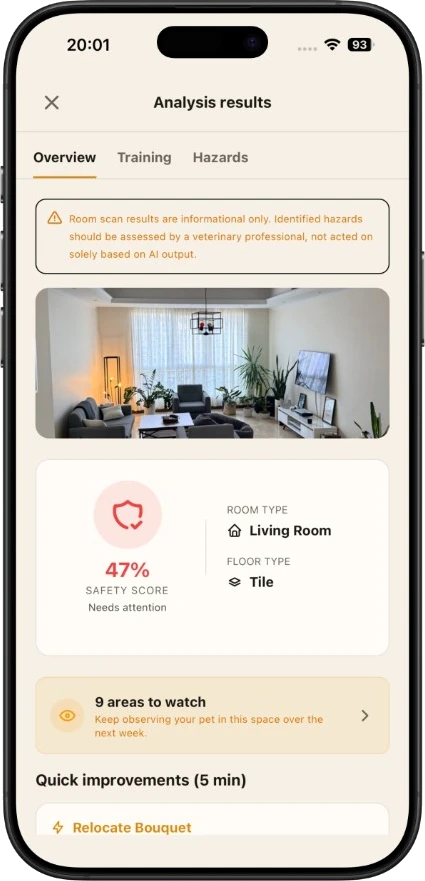
Think of it as a second look at the room you've already prepared — not a guarantee that the room is safe and not a replacement for physically checking the space yourself.
You should still secure cords, remove small objects, check plants, put medication away, and make sure doors and windows are secure.
The room check comes after that work, not instead of it.
Your First-Night Checklist
Save this before your cat comes home:
Set up
- Choose one quiet room.
- Put food and fresh water inside.
- Place the litter box away from food and water.
- Add a safe hiding place.
- Keep the room calm.
Remove hazards
- Clear strings and loose cords.
- Remove small chewable objects.
- Secure windows and doors.
- Check plants using a reputable source.
- Put medication and human food away.
Once your cat arrives
- Let them leave the carrier when they're ready.
- Don't pull them out of hiding.
- Sit quietly in the room.
- Let them approach you.
- Check that food, water, and litter remain accessible.
- Look for visible injury or other concerning changes.
Before bed
- Food available
- Water available
- Litter accessible
- Safe hiding place available
- Room secured
- Cat has space to settle
That's your first night.
You don't need to make the whole house ready at once.
Make one room ready.
Then let your cat take it from there.
Start the First-Night Checklist
If you want to keep the observations from your cat's first night together in one place, you can use Borzi alongside your own room setup routine.
Download Borzi on the App Store
Frequently Asked Questions
Should I let my new cat explore the whole house on the first night?
Usually, starting with one quiet room is a more manageable approach. It gives a new cat a smaller territory to adjust to and makes it easier for you to monitor food, water, and litter-box use. You can gradually expand access as your cat becomes comfortable.
Where should I put the litter box?
Keep it in a quiet, accessible location away from food and water. Your cat should be able to reach it easily without feeling trapped or having to pass through a busy area.
Is it normal for a new cat to hide?
Yes. Hiding can be a normal part of adjusting to a new environment. Give your cat a safe place to hide and let them come out on their own rather than forcing them into interaction.
Should I leave my cat's carrier in the room?
Yes. An open carrier can provide a familiar, enclosed place for your cat to retreat to, particularly if they already associate the carrier with their own scent and bedding.
What should I do if my cat won't eat or drink?
Don't try to diagnose the cause yourself. Monitor the situation and contact your veterinarian for guidance, particularly if your cat refuses food or water, develops other concerning signs, or is very young or has a known medical condition.
Can I use a room scan to make sure the room is safe?
A room scan can provide an additional check for potential hazards, but it should not be treated as a guarantee that a room is safe. Physically checking the room, securing cords and objects, checking plants, storing medication, and securing doors and windows remain your responsibility.
Related reading
- New Kitten First Week Checklist: What to Track Each Day
- Every Little Change: Why Daily Notes Beat One Scan
- Borzi Cat Health Tracker & Daily Check-in
This article is for informational purposes only and does not replace professional veterinary advice. If your cat may have been exposed to something toxic, or shows concerning signs, contact your veterinarian or a poison-control service.
Resources
- Best Friends Animal Society — New cat and safe-room guidance
- ASPCA — Pet-proofing and bringing a pet home
- ASPCA Poison Control — Toxic and non-toxic plants
- ASPCA Animal Poison Control
This article is for informational purposes only and does not replace professional veterinary advice. Always consult your veterinarian for medical decisions.
Ready to monitor your pet's health?
Download Borzi for daily health logs, AI observations, and vet-ready notes in one app.
Download on the App Store