Home Weight vs One Morning at the Clinic
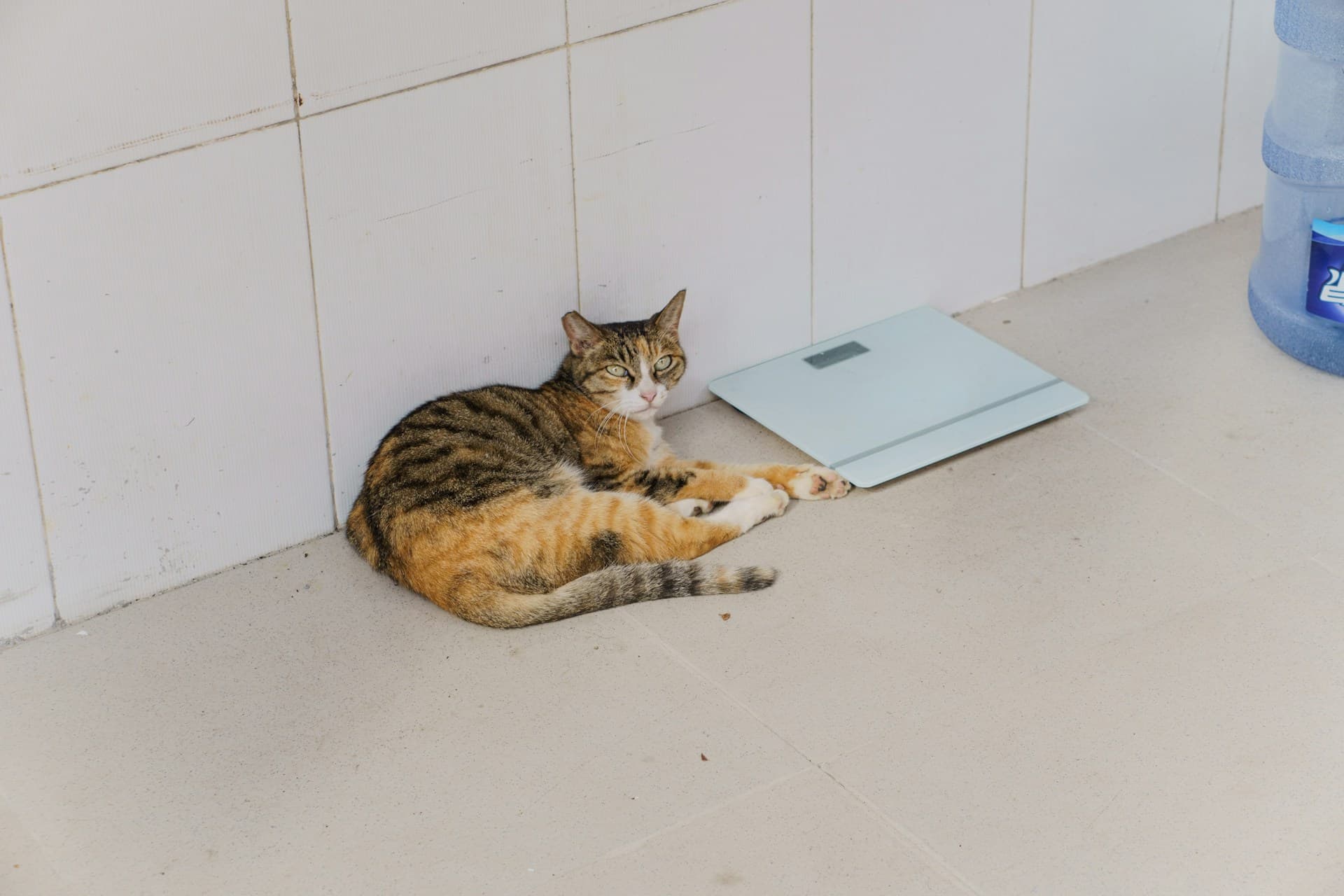
One clinic weigh-in tells you what your cat weighed that morning. A simple home log can show you what has been happening between visits. Here's why the pattern may be more useful than any single number.
The Problem with Treating One Weigh-In as the Whole Story
Your cat steps onto the clinic scale. The number appears. Maybe it is 4.6 kg. A few months later, the number is 4.8 kg.
Is that a meaningful change? Is your cat gradually gaining weight? Was the earlier measurement taken under different circumstances? Or is the difference simply part of normal day-to-day variation?
A clinic weigh-in is still important. Your veterinarian can combine your cat's weight with a physical examination, body condition score, medical history, and other findings. But that appointment gives you one measurement at one point in time.
What happens during the weeks between those appointments is harder to see.
That is where a simple home weight log can become useful.
Instead of asking, "What does my cat weigh today?", you start asking a better question: "What has my cat's weight been doing?"
A Single Number Is a Snapshot, A Log Shows the Pattern
Think about weighing yourself once a year.
You might learn that you weigh 72 kg on the day of the appointment. But that number does not tell you whether you were 70 kg three months ago, 71 kg last month, and slowly moving toward 73 kg.
The same principle applies to cats.
Veterinary guidance recommends monitoring pet weight over time rather than relying only on a single measurement. AAHA specifically recommends regular weigh-ins and keeping a weight journal to identify trends, while VCA notes that small fluctuations can occur and that tracking weight over time can help reveal changes.
The goal isn't to become obsessed with every 20-gram difference. It is to make gradual changes easier to see.
For example:
Imagine your cat's measurements look like this:
- January: 4.4 kg
- February: 4.5 kg
- March: 4.6 kg
- April: 4.7 kg
- May: 4.8 kg
None of those individual changes look dramatic.
But together, they tell a much clearer story than simply knowing that your cat weighed 4.8 kg at the latest appointment.
That is what a trend can give you.
Why Your Home Scale Doesn't Have to Replace the Clinic Scale
There is an important distinction here.
Home weighing is not a replacement for veterinary examinations.
Your veterinarian can assess body condition, muscle condition, physical changes, and other factors that a number on a scale cannot tell you. In fact, VCA recommends combining weight measurements with body-condition assessment rather than using body weight alone.
Instead, think of the two measurements as serving different purposes.
The clinic gives you a professional assessment.
Your vet can put the number into context:
"Your cat weighs 4.8 kg, and based on their body condition and examination, this is where we want them."
Home weighing gives you more observations between appointments.
You might notice:
"The number has slowly increased over the last three months."
Or:
"The weight has been stable for six months."
Or:
"There was a noticeable drop compared with the previous weeks."
Those are very different pieces of information.
And when you bring the home record to your veterinarian, the conversation can start with more than a single number.
The Trick Is Consistency, Not Perfection
A home scale does not need to produce a perfect laboratory measurement to be useful for tracking a trend.
What matters is making your measurements as consistent as reasonably possible.
For example, try to:
- Use the same scale each time
- Weigh your cat in a similar way
- Keep the routine relatively consistent
- Record the measurement rather than relying on memory
- Look at several measurements together instead of reacting to one unusual number
VCA specifically recommends using the same scale and, where possible, keeping the time of measurement consistent to reduce variability.
You also don't necessarily need to weigh your cat every single day.
The appropriate frequency depends on your cat and the reason for monitoring. Cats on a veterinarian-supervised weight-management plan may need more frequent checks, while routine monitoring can be less intensive. Your veterinarian can tell you what schedule makes sense for your cat.
The important part is creating a record that lets you see what is happening between appointments.
How Do You Weigh a Cat at Home?
For smaller cats, a baby scale can be practical because it is designed to measure relatively small weights. VCA also notes that some veterinarians may have owners use a luggage scale or baby scale at home and report the measurements back to the veterinary team.
If your cat refuses to cooperate with a dedicated scale, you may also be able to use a household scale by weighing yourself and then weighing yourself while holding your cat, provided the scale is suitable and the measurements are reasonably consistent.
The exact technique matters less than finding a method that you can repeat without turning every weigh-in into a wrestling match.
And if your cat becomes extremely stressed by being weighed, don't force the issue. Ask your veterinary team about a practical alternative.
Don't Let the Scale Become the Only Thing You Watch
There is another reason not to get fixated on the number.
Body weight isn't the whole picture.
Two cats can weigh the same amount while having different body compositions and body-condition scores.
Veterinary teams commonly use body condition scoring alongside actual body weight to assess whether a cat is carrying an appropriate amount of body fat. VCA recommends recording weight and body condition together when monitoring a cat's weight-management progress. So, if your cat's weight changes, don't immediately assume that something is wrong—or that you should change their food.
Look at the bigger picture.
- Has their body shape changed?
- Has their appetite changed?
- Are they eating normally?
- Is their activity different?
- Have there been changes in their routine?
And most importantly, if the change is concerning or unexplained, talk to your veterinarian rather than trying to solve it by adjusting their diet yourself.
What a Useful Weight Log Actually Looks Like
You don't need a complicated spreadsheet.
A useful log can be as simple as:
| Date | Weight | Note |
|---|---|---|
| Jan 5 | 4.4 kg | Normal |
| Jan 19 | 4.4 kg | Normal appetite |
| Feb 2 | 4.5 kg | — |
| Feb 16 | 4.5 kg | Less active |
| Mar 2 | 4.6 kg | Appetite normal |
Suddenly, your next veterinary appointment has more context.
Instead of:
"I think she's gained some weight."
You can say:
"Her weight has gone from 4.4 kg to 4.6 kg over the last two months."
That's a much more useful starting point for a conversation.
Turn the Numbers into a Graph
This is where a weight log becomes much easier to understand.
A list of numbers requires you to mentally compare them. A graph doesn't.
When measurements are plotted over time, you can see whether the overall line is:
- relatively stable
- gradually increasing
- gradually decreasing
- or changing more abruptly
The graph also helps prevent one unusual measurement from dominating your interpretation.
If your cat normally weighs around 4.5 kg and one measurement says 4.7 kg, you don't necessarily need to panic over that single point.
Look at the measurements around it.
The pattern is the information.
A 20-Second Habit Can Be More Useful Than a Once-a-Year Memory
The biggest obstacle to tracking weight usually isn't understanding why it matters. It's remembering to record it.
You weigh your cat. You think, I'll remember that. Then three weeks later, you have absolutely no idea whether the number was 4.4, 4.5, or 4.6 kg.
That is why keeping the record immediately matters.
With Borzi, you can record your cat's weight and keep the measurements together over time, turning individual entries into a visual record rather than leaving them scattered across notes, screenshots, or memory.
The point isn't to create another task that you have to manage perfectly. It's to make the information you are already collecting easier to understand.
What Should You Do If the Trend Changes?
This is where the distinction between tracking and diagnosing matters.
A weight graph can tell you that something changed.
It cannot tell you why.
Unexpected weight loss or gain can have many possible explanations, ranging from changes in food intake and activity to underlying health problems. Veterinary assessment is needed to determine what a concerning change means.
So, if you notice a persistent, significant, or otherwise concerning change:
Don't try to diagnose it from the graph.
Bring the information to your veterinarian.
A record of when the change started, how quickly it happened, and what happened around the same period can give your veterinary team useful context.
Home Weight vs. Clinic Weight: You Don't Have to Choose
The real question isn't whether the home scale or the clinic scale is "better."
They answer different questions.
The clinic asks:
What does my cat weigh today, and what does that mean in the context of their examination?
The home log asks:
What has my cat's weight been doing between appointments?
You need both perspectives.
One gives you a professional assessment at a particular point in time. The other gives you a record of what happened in between. And sometimes, that second piece is what makes the first one more informative.
Don't just remember today's number.
Keep the pattern.
Frequently Asked Questions
How often should I weigh my cat at home?
There isn't one schedule that is right for every cat. Cats undergoing a veterinarian-supervised weight-management program may need more frequent measurements, while routine monitoring may require less frequent checks. Ask your veterinarian what interval makes sense for your cat.
Is a home scale accurate enough for my cat?
A suitable home scale can be useful for monitoring trends, particularly when you use the same scale and a consistent weighing method. Your veterinarian can also periodically compare your home measurements with their clinic measurements if needed.
Should I worry about a small change in my cat's weight?
Not necessarily. Small fluctuations can happen. The more useful question is whether the change forms part of a persistent trend or occurs alongside other changes. If you're concerned about unexplained weight loss or gain, contact your veterinarian.
Can I use my regular bathroom scale?
For smaller cats, a baby scale may provide a more practical option because it is designed to measure smaller weights. If you use a household scale, consistency is important, and you should choose a method that gives you repeatable measurements.
Does my cat's weight tell me if they are healthy?
Not by itself. Weight should be considered alongside body condition, muscle condition, physical examination, diet, activity, and other aspects of your cat's health. A veterinarian can help put the number into context.
This article is for informational purposes only and does not replace professional veterinary advice. Always consult your veterinarian before changing your cat's diet or weight-management plan.
Resources
- VCA Animal Hospitals — How to Know if Your Pet Is Overweight
- VCA Animal Hospitals — Creating a Weight Reduction Plan for Cats
- VCA Animal Hospitals — Tips for Successful Weight Loss in Dogs and Cats
- AAHA — 5 Ways to Know How Much to Feed Your Pet
- VCA Animal Hospitals — Body Condition Score in Cats
This article is for informational purposes only and does not replace professional veterinary advice. Always consult your veterinarian for medical decisions.
Ready to monitor your pet's health?
Download Borzi for daily health logs, AI observations, and vet-ready notes in one app.
Download on the App Store