How to Build Your Cat's 7-Day Health Baseline (And Why One Good Day Isn't Enough)

One good day tells you how your cat seemed today. It doesn't tell you what's normal for them.
A cat health baseline is a simple record of your cat's usual habits, including how they eat, drink, use the litter box, rest, play, and maintain their weight. When you observe these patterns over several days, you start to build a more useful picture of your individual cat.
You don't need to measure everything or keep a perfect daily streak. Start with a few observations, repeat them for seven days, and look for patterns rather than isolated moments.
What Is a Cat Health Baseline?
A cat health baseline is a personal reference point for your cat's everyday behavior and physical condition.
It isn't a list of textbook numbers every cat should match. Cats differ in their appetite, activity, preferred sleeping spots, drinking habits, and body size. Age, diet, environment, and existing health conditions can also affect what is typical for an individual cat.
For example, one cat might spend much of the afternoon sleeping on a sofa, while another regularly moves between several rooms. Both patterns can be normal for those cats. What matters is understanding your cat's usual routine well enough to recognize a meaningful change.
A baseline also isn't a diagnosis or proof that your cat is healthy. It gives you useful context when deciding whether something deserves closer attention or a conversation with your veterinarian.
The goal is simple: learn what your cat usually does before you need to explain what has changed.
The Four Daily Signals to Track
You don't need a complicated spreadsheet or a long examination. Focus on four areas that are practical to observe at home.
1. Appetite and Water Intake
Start with what your cat eats and drinks.
Each day, notice:
- Whether your cat eats their usual meals.
- Whether they leave more food than usual or seem unusually hungry.
- Whether you notice a change in how often they drink.
- Whether changes in food or feeding routines could explain a difference.
You don't have to calculate every calorie or measure every sip to begin building a baseline. Consistent observations are a useful starting point.
Remember that cats eating wet food get a substantial amount of water from their meals, so drinking directly from the bowl doesn't tell the whole story. Changes in thirst, appetite, or eating behavior are more useful when considered together.
If you have multiple cats, try to observe meals separately when practical. An empty shared bowl doesn't necessarily tell you which cat ate.
2. Litter-Box Habits
The litter box provides another everyday source of information.
Notice:
- Whether your cat appears to urinate and defecate as usual.
- Whether the number or size of urine clumps seems different.
- Whether stools appear noticeably harder, looser, or more frequent.
- Whether your cat repeatedly enters the box, strains, vocalizes, or starts eliminating outside it.
You don't need to document every trip. A short note about a clear change is often enough to help you remember what happened.
Litter-box changes can have different causes, and observations alone cannot identify the reason. If your cat strains to urinate, repeatedly tries without producing urine, or has difficulty breathing, seek immediate veterinary care rather than continuing to track symptoms. Inability to urinate can be life-threatening.
3. Energy, Activity, and Resting Habits
Cats sleep a lot, so a long nap by itself isn't necessarily concerning. The useful question is whether your cat's routine looks different from their own usual pattern.
Notice:
- When they tend to be active.
- Whether they still show interest in familiar toys or activities.
- Whether they move around the home as usual.
- Where they typically rest.
- Whether they suddenly hide more or interact less than usual.
For example, if your cat normally greets you in the evening but suddenly spends most of that time hidden away, that difference is worth noting. It doesn't automatically mean they're ill, but it gives you a specific observation to consider alongside appetite, litter-box habits, and other changes.
Try to describe what you see instead of assigning a score without context. "Played with the feather toy for a few minutes" or "stayed under the bed most of the evening" is more informative than simply writing "good" or "bad."
4. Weight at Home
Weight gives you a different kind of reference point because gradual changes may be difficult to notice by looking at your cat.
If you have a suitable scale, weigh your cat under similar conditions and record the result. For a small cat, you may find it easier to weigh yourself while holding the cat and then subtract your own weight, provided the scale is reliable enough for the task.
For more consistent comparisons:
- Use the same scale.
- Weigh at roughly the same time of day.
- Keep the method as consistent as possible.
- Record the date with each measurement.
For a general baseline, one measurement at the beginning and another near the end of the week may be a practical starting point. You don't need to weigh your cat every day.
Weight can fluctuate, and a single reading may not tell you much on its own. If your cat is a growing kitten, has a known medical condition, or has been advised to follow a specific weight-monitoring schedule, ask your veterinarian how frequently to weigh them.
How to Build Your Cat's 7-Day Baseline
You don't need seven perfect days of records. You need enough observations to begin understanding the pattern.
Three to five days of notes can give you an initial reference point. By the end of a week, you may have a clearer sense of what tends to repeat and which observations were unusual.
Here's a simple plan you can follow.
Your 7-Day Cat Health Baseline Checklist
| Day | What to observe | What to record |
|---|---|---|
| Day 1 | Establish your starting point | Usual meals, water habits, litter-box use, energy, and resting spots |
| Day 2 | Look for repetition | Which habits seem similar to yesterday? |
| Day 3 | Start comparing | Any clear differences in appetite, activity, or litter-box habits? |
| Day 4 | Keep the routine consistent | Continue observing without changing several things at once |
| Day 5 | Review the early pattern | Which behaviors have repeated over several days? |
| Day 6 | Check for context | Note changes in food, visitors, routine, or environment |
| Day 7 | Review the week | Summarize your cat's usual patterns and any changes worth discussing with a vet |
This isn't a pass-or-fail challenge. If you miss a day, continue when you can. A useful record is better than an abandoned one because you couldn't maintain a perfect streak.
What Should Your Daily Notes Look Like?
Keep them short enough that you can realistically maintain the habit.
For example:
- Appetite: Ate the usual breakfast and dinner.
- Water: No obvious change in drinking.
- Litter box: Urine clumps and stools appeared typical.
- Energy: Played briefly in the evening, then rested on the sofa.
- Other observations: Spent more time under the bed while visitors were over.
These notes describe what happened without trying to explain why. If you notice a change, you can add relevant context, such as a new food, a change in household routine, or an unusual event.
You don't need to turn every small variation into a concern. Instead, look for changes that are persistent, pronounced, or accompanied by other unusual signs.
Why Three to Five Days of Notes Can Be More Useful Than One Good Day
One observation is a snapshot. Several observations begin to provide context.
Imagine your cat eats less at dinner one evening. By itself, that tells you very little about whether the behavior is typical. Your cat might have eaten a larger meal earlier, experienced a change in routine, or simply behaved differently that evening.
Now imagine you've been keeping notes for five days. You know what your cat usually eats, and you can compare the observation against that pattern. You still cannot determine the cause from the notes alone, but you have a clearer description of the change.
The same applies to activity, resting habits, and litter-box behavior.
A few days of observations can help you distinguish between:
- A familiar pattern: Your cat tends to rest in the same place every afternoon.
- An isolated variation: Your cat plays less one evening but returns to their usual behavior.
- A change worth investigating: Your cat repeatedly eats less than usual or starts hiding much more often.
Seven days isn't a scientific threshold that guarantees a reliable baseline. It's a practical starting period that encourages consistent observation without making the process burdensome.
And don't wait for the week to finish if something concerning happens. A baseline is a reference tool, not a reason to delay veterinary care.
Take a Few Reference Photos on Day One
Written notes are useful, but photographs can help you remember what your cat looked like when you first started tracking.
Take a few clear, calm photos in good natural light or another well-lit area. Avoid flash if it startles your cat, and don't restrain them just to get a picture.
Useful reference photos may include:
- Eyes: A clear view of both eyes, taken while your cat is relaxed.
- Ears: The outside of each ear, without forcing the ears open or inserting anything.
- Skin and coat: A view of the coat and any visible areas you want to compare later.
- Full body: A relaxed standing or sitting view that helps you remember your cat's general appearance.
Keep the images dated so you can compare them over time. You can also add a short note about anything you notice, such as a patch of fur that looks different from the surrounding coat.
These photographs are references, not a substitute for a veterinary examination. They also won't reveal every health problem. If you notice an injury, unusual discharge, a painful-looking area, or another concerning change, contact your veterinarian instead of relying on photo comparisons.
When Should You Contact a Veterinarian?
A baseline can help you recognize changes, but some signs should prompt action before you've finished collecting a week's worth of information.
Contact a veterinarian promptly if your cat hasn't eaten for 24 hours. Seek immediate veterinary care for breathing difficulty or straining to urinate, particularly if little or no urine is coming out. If your cat repeatedly attempts to use the litter box without producing urine, don't wait to see whether the behavior appears in tomorrow's notes.
Other changes worth discussing with your veterinarian include:
- A persistent change in appetite or thirst.
- Repeated vomiting or diarrhea.
- Noticeable weight loss.
- A sudden change in activity or behavior.
- Hiding much more than usual, especially alongside other changes.
- New difficulty moving, jumping, grooming, or using the litter box.
The appropriate response depends on the sign and its severity. If your cat seems seriously unwell or you are unsure how urgently they need care, contact a veterinary professional for guidance.
Your notes can make that conversation more specific. Instead of saying "something seems off," you may be able to explain what changed, when you first noticed it, and whether other habits changed at the same time.
How Borzi Can Help You Build a Baseline
Once you understand what to observe, the next challenge is remembering to do it consistently.
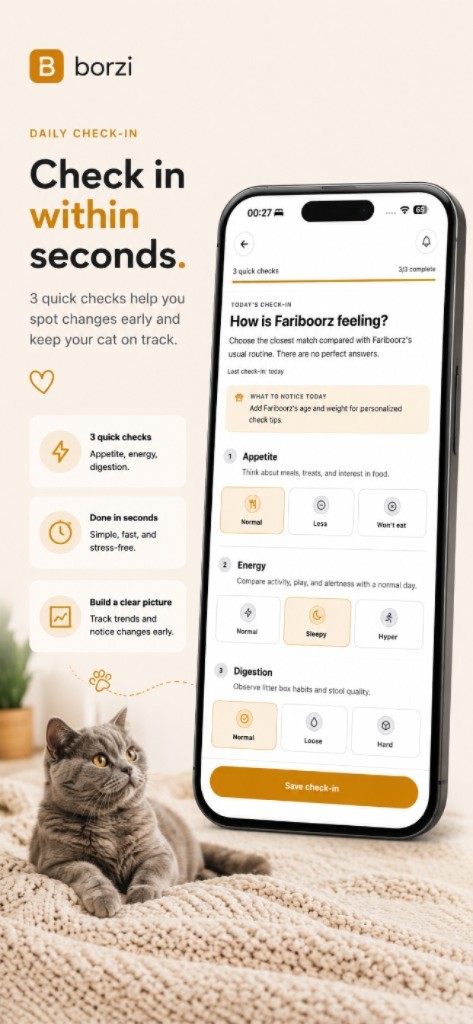
Borzi's 30-second Today check-in gives you a simple place to record everyday observations, including appetite, energy, and digestion. Over the first three to five days, those entries can begin to form a reference point for your cat's recent habits.
The aim isn't to turn pet care into a daily scoring exercise. It's to make short, useful observations easier to keep in one place.
After seven days, you can review what you've recorded and consider which habits seem consistent and whether anything deserves closer attention. Borzi can help organize those observations, but it doesn't diagnose illness or replace veterinary advice.
Start Small, Then Keep Going
You don't need a complete health history to begin. Start with the habits you can observe today, record what you notice, and repeat the process when you can.
If you miss a day, simply continue. If you notice a concerning change, act on it rather than waiting for a full week's record.
Start your cat's 7-day baseline in Borzi and build a clearer picture of their everyday habits, one short check-in at a time.
Download Borzi on the App Store
Frequently Asked Questions
What is a normal health baseline for a cat?
A normal baseline is the pattern of behavior and physical observations typical for your individual cat. It may include eating and drinking habits, litter-box use, energy, resting places, and weight. It isn't a universal number or a guarantee that your cat is healthy.
How long does it take to establish a cat health baseline?
Three to five days of consistent notes can provide an initial reference point. A full seven-day record gives you more opportunities to compare observations, but some patterns take longer to understand. The right timeframe depends on your cat and what you're tracking.
Do I need to track my cat every day?
Daily observations can make patterns easier to recognize, especially when you're first getting to know a new cat. But you don't need a perfect streak. If you miss a day, continue recording when you can.
Should I weigh my cat every day?
Not usually for a general baseline. A starting measurement and a follow-up measurement under similar conditions can be useful. Kittens and cats with specific health or weight concerns may need a different schedule, so ask your veterinarian what is appropriate.
Can a cat health baseline tell me if my cat is sick?
No. A baseline can help you recognize changes and describe them more clearly, but it cannot diagnose the cause. Contact your veterinarian if you notice concerning changes, and seek immediate care for breathing difficulty or straining to urinate.
What if I just adopted my cat?
Your cat may still be adjusting to a new environment, so their first few days may not fully represent their longer-term routine. Start recording what you observe without expecting an immediate pattern. If your cat isn't eating, seems unwell, or has difficulty urinating or breathing, don't assume it's just adjustment. Contact a veterinarian.
Related reading
- Indoor Cats Still Need Daily Health Notes
- New Kitten First Week Checklist: What to Track Each Day
- Home Weight vs One Morning at the Clinic
- What to Bring to Your Cat's Vet Appointment
This article is for informational purposes only and does not replace professional veterinary advice. If your cat may need urgent care, contact your veterinarian or an emergency clinic.
Resources
- AAHA / AAFP — history and exam by life stage
- VCA — Caring for Your Sick Cat (daily eat/drink/pee/poop monitor)
- International Cat Care — Inappetence in cats
This article is for informational purposes only and does not replace professional veterinary advice. Always consult your veterinarian for medical decisions.
Ready to monitor your pet's health?
Download Borzi for daily health logs, AI observations, and vet-ready notes in one app.
Download on the App Store